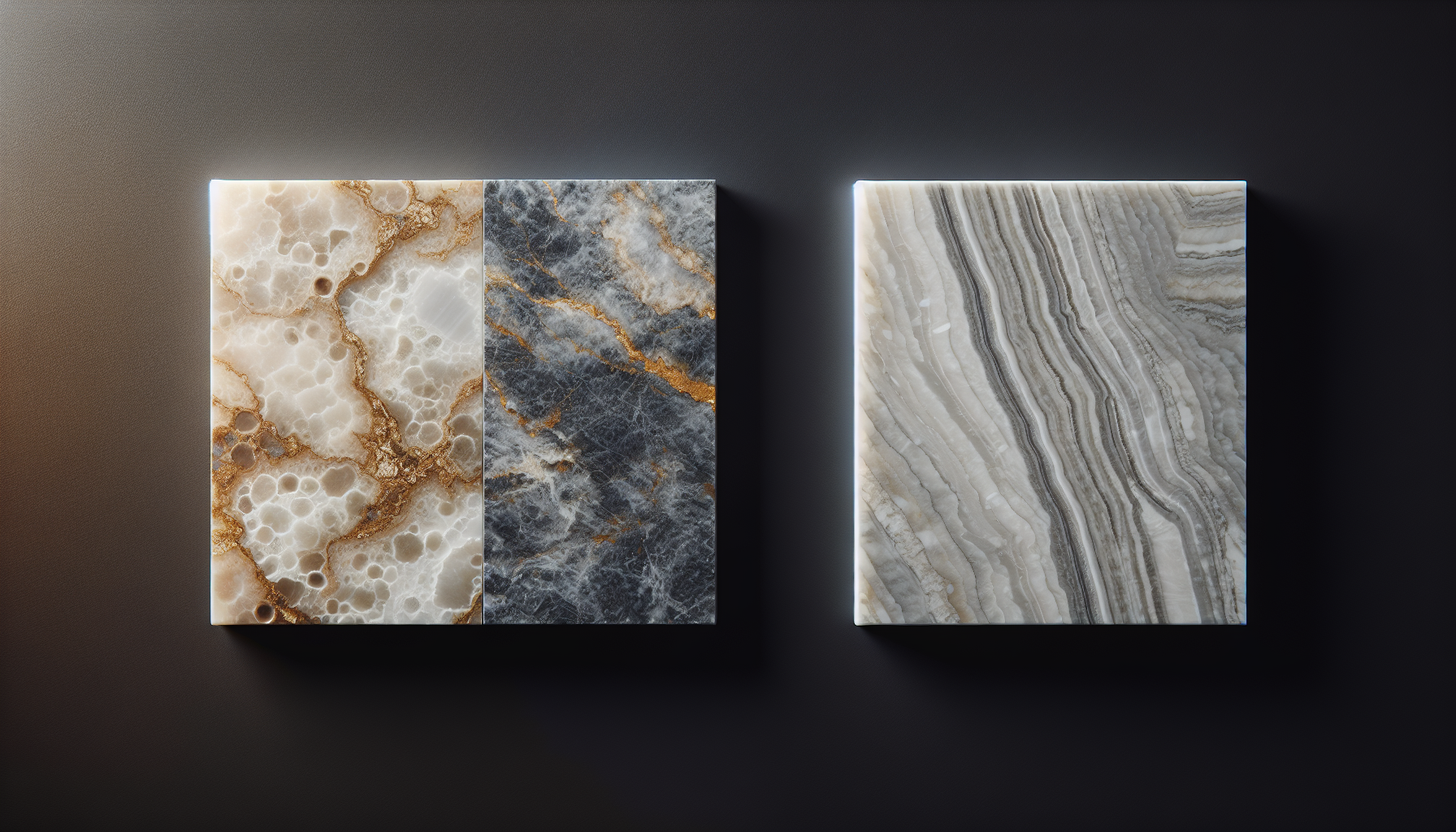
Quartzite vs Quartz

Natural Stone vs Engineered Surface

They sound the same. They are not. One comes from a quarry, the other from a factory. This guide compares every detail so you can choose with confidence.

Quartzite

  • +100% natural stone, mined from quarries worldwide
  • +Exceptional heat resistance: place hot pans directly on the surface
  • +Every slab is unique with natural veining and depth
  • +Near-diamond hardness (7 Mohs), extremely scratch-resistant
  • -Requires annual sealing to maintain stain resistance
  • -$60-120/sq ft installed, higher fabrication costs

Quartz

  • +Engineered for consistency: same pattern slab after slab
  • +Non-porous surface that resists stains without sealing
  • +Zero maintenance: just wipe with soap and water
  • +$50-100/sq ft installed, hundreds of colour options
  • -Cannot handle hot pans: resin melts above 300°F
  • -Yellows in direct sunlight, unsuitable for outdoor kitchens

Origins and Composition

Quartzite

Sandstone transformed by extreme heat and pressure over millions of years deep within the earth. 100% natural, each slab is unique. Quartzite is one of the hardest natural stones available, second only to diamond and topaz in hardness. It starts as grains of sand that fuse together under geological forces into a dense, crystalline rock.

Quartz

90-94% ground quartz crystals mixed with 6-10% polymer resins and pigments, then pressed into slabs in a factory using vibro-compression. The raw mineral (quartz) is natural, but the finished countertop is manufactured. This process allows precise control over colour, pattern, and consistency that natural stone cannot match.

Key takeaway: one comes from a quarry, one comes from a factory.

Side-by-Side Comparison

14 categories compared head to head. Quartzite wins on performance. Quartz wins on convenience.

PropertyQuartziteQuartzEdge
Material Type100% natural stone, mined from quarriesEngineered composite (90-94% ground quartz, 6-10% resin and pigments)Draw
Cost per Sq Ft (Installed)$60 - $120 (premium slabs up to $150+)$50 - $100 (premium brands at high end)Quartz wins
Heat ResistanceExcellent. Place hot pans directly on the surface without damagePoor. Resin melts or discolours above 300°F. Always use trivetsQuartzite wins
Stain ResistanceGood when sealed. Porous surface needs annual sealing to resist stainsExcellent. Non-porous, resists stains from wine, oil, and coffeeQuartz wins
MaintenanceSeal annually ($100-300 DIY). Use pH-neutral cleaners. Blot spills promptlyVirtually zero. Wipe with soap and water. No sealing ever neededQuartz wins
Scratch ResistanceExcellent. 7 on Mohs scale (near diamond hardness). Very hard to scratchGood. Resists most everyday scratches but softer than quartziteQuartzite wins
AppearanceUnique veining, translucent depth, natural movement. Every slab is one-of-a-kindConsistent patterns, hundreds of colours. Same look slab after slabDraw
UV ResistanceExcellent. Will not fade in direct sunlight. Suitable for outdoor usePoor. Resin yellows in direct sunlight. Indoor use onlyQuartzite wins
Durability / LifespanLasts essentially forever with proper care. Survived geological forces15-25+ years. Resin can eventually yellow or degrade near heat sourcesQuartzite wins
Edge ProfilesAll profiles available but harder stone means higher fabrication costAll profiles available. Easier to fabricate, lower edge profile costQuartz wins
InstallationProfessional only. Harder to cut, fewer fabricators, longer lead timesProfessional only. Uniform material, simpler layout, faster turnaroundQuartz wins
RepairabilityChips can be filled and surface repolished to near-original conditionChips are harder to repair invisibly due to the engineered compositionQuartzite wins
Resale ValueStrong. Perceived as premium natural stone, edges ahead in luxury marketsStrong. Widely recognized and valued by home buyersQuartzite wins
Outdoor KitchensYes. Handles UV, heat, and weather with no degradationNo. UV causes yellowing and resin breakdown. Indoor onlyQuartzite wins

7

Quartzite wins

5

Quartz wins

2

Draws

Which Fits Your Lifestyle?

Real scenarios, honest recommendations.

The Avid Home Cook

You drop cast iron pans, splash red wine, and use the stovetop daily. You want a surface that can handle the heat.

Quartzite handles hot pans beautifully, but seal it well to protect against stains from oil and wine.

Best pick: Quartzite

The Busy Family

Kids, homework on the counter, juice spills, and zero time for annual maintenance rituals.

Quartz wins decisively. Wipe it down, move on. No sealing, no special cleaners, no worries.

Best pick: Quartz

The Design Purist

You are building a showpiece kitchen and want something that starts conversations.

Quartzite delivers natural movement and depth that no factory can replicate. Each slab is art.

Best pick: Quartzite

The Outdoor Kitchen Builder

Your countertop will see direct sunlight, rain, and temperature swings year-round.

Quartzite only. Quartz resin yellows and degrades in UV light. Not an option for outdoor use.

Best pick: Quartzite

Which Is Right for Your Kitchen?

Answer 6 quick questions and get a personalized recommendation based on your cooking habits, budget, and style.

1.How often do you cook with high heat (cast iron, woks, broiling)?

2.How do you feel about annual sealing and maintenance?

3.What is your budget per square foot (installed)?

4.What matters more in appearance?

5.Where is this countertop going?

6.Do you want a countertop that is truly one-of-a-kind?

Cost Calculator

Enter your project details to see estimated costs for both quartzite and quartz countertops.

Average kitchen: 30-50 sq ft. Large kitchen with island: 50-80 sq ft.

Quartzite Estimate

Low estimate$2,760
Mid-range$4,140
High estimate$5,520

+ Annual sealing: $100-$300/year (DIY) or $200-$500 (professional)

Quartz Estimate

Low estimate$2,300
Mid-range$3,450
High estimate$4,600

No ongoing maintenance costs. Just soap and water.

Potential Savings with Quartz

Upfront difference (mid-range)$690

Over 10 years, quartzite sealing adds $1,000-$3,000 in maintenance costs that quartz avoids.

Care and Maintenance

The biggest practical difference between these two materials is maintenance. Here is what each requires.

Quartzite Care

  • 1.Seal annually. Apply a quality stone sealer once a year. Takes 30-60 minutes. Cost: $100-300 DIY, $200-500 professional.
  • 2.Use pH-neutral cleaners. Avoid vinegar, lemon juice, or harsh chemicals that can strip the sealer. Use stone-specific or pH-neutral dish soap.
  • 3.Blot spills promptly. While sealed quartzite resists most stains, do not let red wine, oil, or acidic liquids sit for hours. Blot, do not wipe.
  • 4.Water test your sealer. Drop water on the surface. If it beads up, the seal is good. If it soaks in, time to reseal.

Quartz Care

  • 1.Wipe with soap and water. That is all. Warm water and mild dish soap handles everyday cleaning. No special products needed.
  • 2.Always use trivets. Despite marketing claims, quartz is not truly heat-proof. The resin melts above 300°F. Always place hot pans on trivets or hot pads.
  • 3.Avoid harsh chemicals. Skip bleach, oven cleaners, and highly alkaline products. These can dull the finish over time.
  • 4.No sealing required. Ever. Quartz is non-porous, so there is nothing for liquid to penetrate. This is its biggest practical advantage.

Common Myths Debunked

The similar names create widespread confusion. Here are the facts behind the most common misconceptions.

!

Myth: “Quartz is a natural stone

Quartz countertops are engineered. They are made from roughly 90-94% ground quartz crystals mixed with 6-10% polymer resins and pigments, then pressed into slabs in a factory. The raw mineral (quartz) is natural, but the finished countertop product is manufactured.

!

Myth: “Quartzite stains easily

When properly sealed, quartzite is highly stain-resistant. The key is annual sealing and blotting spills promptly rather than letting them sit. Many quartzite slabs are quite dense and absorb very little liquid even without sealer. The staining reputation comes from improperly sealed or poorly maintained installations.

!

Myth: “Quartzite and quartz are the same thing

They are completely different materials. Quartzite is a natural metamorphic rock formed when sandstone is subjected to extreme heat and pressure deep in the earth. Quartz countertops are an engineered product made in a factory. The similar names cause enormous confusion at showrooms.

!

Myth: “Quartz countertops are indestructible

Quartz is very durable for everyday use, but it is not indestructible. The resin binder can melt or discolour from hot pans (above 300°F), fade or yellow from UV exposure, and chip along edges from heavy impacts. It is also not suitable for outdoor kitchens.

!

Myth: “Quartzite is just expensive marble

Quartzite and marble are completely different rocks. Marble is metamorphosed limestone (calcium carbonate) and is soft and acid-sensitive. Quartzite is metamorphosed sandstone (silicon dioxide) and is one of the hardest natural stones. Quartzite is far more durable than marble in kitchen applications.

!

Myth: “You can skip sealing quartzite if you buy a dense slab

While some quartzite slabs are denser than others, sealing is still recommended for kitchen countertops. Even dense quartzite has micro-pores that can absorb oils and coloured liquids over time. The cost and effort of annual sealing is minimal compared to the cost of stain removal or replacement.

Frequently Asked Questions

What is the difference between quartzite and quartz countertops?
Quartzite is a 100% natural stone formed when sandstone is subjected to extreme heat and pressure over millions of years. Quartz countertops are engineered products made from 90-94% ground quartz crystals mixed with 6-10% polymer resins and pigments. One comes from a quarry, the other from a factory.
Is quartzite more expensive than quartz?
Generally yes. Quartzite typically costs $60-120 per square foot installed, while quartz costs $50-100 per square foot installed. Premium quartzite varieties like Taj Mahal can reach $150+ per square foot. Quartzite also has ongoing sealing costs of $100-300 per year.
Can you put hot pans on quartzite?
Yes. Quartzite is highly heat-resistant and can handle hot pans placed directly on the surface without damage. This is one of quartzite's biggest advantages over quartz, which can melt or discolour from heat above 300 degrees Fahrenheit due to its resin content.
Does quartz need to be sealed?
No. Quartz countertops are non-porous and never need sealing. Simply wipe them down with soap and water. This is one of the main advantages of quartz over quartzite, which requires annual sealing to maintain stain resistance.
Which is better for outdoor kitchens, quartzite or quartz?
Quartzite is the only option for outdoor kitchens. Quartz countertops cannot handle UV exposure, which causes the resin to yellow and degrade over time. Quartzite is a natural stone that handles sunlight, heat, and weather without any issues.
How long do quartzite and quartz countertops last?
Quartzite lasts essentially forever with proper care, as it is a geological material that survived millions of years of natural forces. Quartz countertops have a lifespan of 15-25+ years, after which the resin binder can begin to yellow or degrade, particularly near heat sources.
Does quartzite scratch easily?
No. Quartzite rates 7 on the Mohs hardness scale, making it one of the hardest natural stones available for countertops. It is harder than granite and significantly harder than marble. Most kitchen items will not scratch quartzite, though cutting directly on any countertop is not recommended.
Is quartz a natural stone?
No. Despite the name, quartz countertops are engineered products manufactured in factories. They contain 90-94% ground natural quartz crystals, but these are bound together with 6-10% polymer resins and pigments to create the finished slab. Quartzite is the natural stone option.